Msgr. Roger J. Landry
National Blue Army Shrine, Ashbury, NJ
109th Anniversary Celebration of the Second Apparition of Our Lady of Fatima
Memorial of the Immaculate Heart of Mary
June 13, 2026
Jud 13:17-20.15:9, Lk 1:46-55, Lk 2:41-51
To watch a video of the talk, please click below:
To listen to an audio recording of today’s homily, please click below:
The following text guided the homily:
- In 1969 Saint Pope Paul VI moved the Feast of the Immaculate Heart of Mary from August 22 to the day immediately after the Solemnity of the Sacred Heart in order to highlight the connection between the two great feasts. Two days ago, the Bishops of the United States consecrated our country to the Sacred Heart of Jesus and yesterday, together with our brothers and sisters throughout the world, we celebrated the solemnity of Jesus’ Sacred Heart. We prayed with devotion on both days, with words taken from Jesus’ words in Matthew 11, “O Jesus, meek and humble of heart, make our hearts like unto thine.”
- The truth is, if we wish to have a heart like Jesus’, if we wish to have our beloved country as we mark its 250thbirthday learn anew how to love with the divine and human fire that burned in the heart of Jesus, we need to turn to Mary, from whom Jesus received his human heart, and learn from her how to respond to the love of Jesus’ heart and be transformed by it. The beat of Mary’s heart was the first thing Jesus heard as soon as his human ears began to function. Hers is the heart that most received and best reflects her Son’s love. The Memorial of Mary’s Immaculate Heart is a day on which we seek not only to admire her, not only to imitate her, but to enter into her loving relationship with her Son. If we wish not just to make but live well a consecration to Jesus’ Sacred Heart, the shortest and surest path is through consecration to Mary’s immaculate heart. Her heart is the most similar to his. Her heart, and her whole life, body, mind and soul, were totally cut off from worldliness to be fully his. Today we say, with St. Louis Marie Grignion de Montfort’s prayer of consecration that St. John Paul II used to pray this every morning, “Praebe mihi cor tuum, O Maria!,” “Give me your heart, O Mary!,” so that with you, I may receive, remain in, delight in, and spread the love of the heart of Jesus!
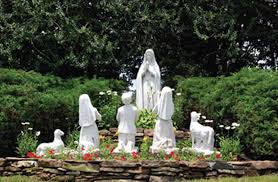
- It was 109 years ago today, on June 13, 1917, that Mary first revealed to Sister Lucia that she wanted her to remain in the world because she was His chosen instrument “to establish in the world devotion to my Immaculate Heart.” It was on June 13, 1917 that Mary promised her, “My Immaculate Heart will be your refuge and the way that will lead you to God.” And it would be the next month that Mary would speak specifically of consecration to her immaculate heart.
- We remember the context. She showed 7-year-old Jacinta, 9-year-old Francisco and 10-year-old Lucia a vision of hell where poor sinners go. She gave them a glimpse of the destruction that would come from atheistic communism. She had permitted them to see how much the Church would suffer, with a vast city of Christian corpses and even a bishop in white assassinated. After these visions, Our Lady said to them, “You have seen hell where the souls of poor sinners go. To save them, God wishes to establish in the world devotion to myImmaculate Heart. If what I say to you is done, many souls will be saved and there will be peace.” Our Lady went on specifically to request that Russia — which in 1917 was experiencing the beginning of the Bolshevik revolution — be consecrated to her Immaculate Heart, lest Russian communism “spread its errors throughout the world, causing wars and persecutions of the Church.” Atheistic communism, for our Lady, was not a neutral political system, but a violent conceptual attack on God and on those made in his image that would bring incalculable harm, as we saw over the course of the 20th century.
- But we have to ask what it means to consecrate ourselves, or particular countries, or the world to Mary’s Immaculate Heart? It means first and fundamentally to entrust ourselves to Our Lady, to belong to her, to enter into a covenant with her. At a deeper level, consecration to her “immaculate heart” means to beg her to help make our heart like hers, since Jesus declares that “the pure of heart shall see God” (Mt 5:8). The future Pope Benedict, commenting in 2000 on Mary’s message in Fatima, said that Mary’s is a “heart that, with God’s grace, has come to perfect interior unity and therefore ‘sees God.’ To be ‘devoted’ to the Immaculate Heart of Mary means therefore to embrace this attitude of heart, which makes the fiat—‘your will be done’—the defining center of one’s whole life.” Mary wants us to have such a heart. Jesus wants us to have such a heart.
- Today we contemplate her heart, a heart that was full of grace because it was full of God. It was a heart full of thanksgiving, one that, as we see in the Magnificat today that was the response to the first reading that pronounced her “the highest honor of our race,” Mary proclaimed that her heart, soul and spirit rejoiced in God’s greatness and salvation. Her’s was a contemplative heart that, as we heard at the end of today’s Gospel, “kept all these things, pondering them in her heart.” The Greek words St. Luke uses about her heart at the Nativity and in the Finding of the Temple — syntereo and symballo — which mean that she cherished in her heart the words that came to her from God and pieced them together like a priceless mosaic, a treasure that kept paying out dividends within her, pondering God’s word so profoundly that that word could take on her flesh.
- One of the best meditations on Mary’s immaculate heart and one of the best ways to learn from it is the Preface of the Votive Mass of the Immaculate Heart of the Blessed Virgin Mary, which we will pray later in today’s Mass. It’s from the most beautiful liturgical book in the Latin Rite: the Collection of Masses of the Blessed Virgin Mary. It gives us eight adjectives that describe her heart and chart for us the path to a heart like hers. The Preface reads: “You gave the Blessed Virgin Mary a wise and obedient heart, that she might perfectly carry out your will, a new and gentle heart, in which you were well pleased and on which you inscribed the law of the New Covenant. You gave her an undivided and pure heart that she might be worthy to be the Virgin Mother of your Son and to rejoice to see you forever. You gave her a steadfast and watchful heart, so that she could endure without fear the sword of sorrow and await in faith the resurrection of her Son.” We can briefly ponder each of the attributes, which refer to the type of heart she wants us to have:
- Wise — Her heart was like the young Solomon’s, because pondering and treasuring everything as pieces of a mosaic within. It was wise because it was filled with God’s wisdom.
- Obedient — Her heart hears the word of God and keeps it, perpetually saying fiat. When the anonymous woman from the crowd screamed to Jesus, “Blessed is the womb that bore you and the breasts that nursed you,” he, even though no woman’s womb or breasts were ever as blessed as Mary’s because of their association with him, upped the ante in his praise saying, “Blessed, rather, are they who hear the word of God and observe it.” Mary’s real beatitude came from her holy obedience that lived in complete harmony with God’s will and whose whole life developed according to her response to Gabriel, “Let it be done to me according to your word.” Wisdom that allows us to see things as God does, and obedience that helps us to live that wisdom, is what allows us “perfectly [to] carry out [God’s] will.”
- New — In her heart we see the fulfillment of God’s promises through Ezekiel to give us a new heart, taking away our stony hearts and giving us hearts of flesh, hearts that beat in love.
- Gentle — Her heart was one that learned from her Son, who says, “Learn from me for I am gentle and humble of heart.” The freshness and meekness of a heart like Mary’s pleases God, as the Preface says, and is the proper writing material for the Holy Spirit upon which inscribe the new law.
- Undivided — From the moment her immaculate heart first formed in St. Anne’s womb, it sought above all God’s kingdom as the pearl of great price worth everything else. Hers was an unbroken echo chamber of an Amen to all God’s desires.
- Pure — The pure of heart see God, as Jesus mentions in the Beatitudes, and her heart did, because there was no room in it for sin. The untainted eyes of her heart allowed her to see God in her Son growing within her from his first moments and to rejoice in him.
- Steadfast — Her heart persevered through vicissitudes. It loved on despite being pierced so many times. At the Presentation, Simeon foretold that her own heart would be pierced on account of her Son’s being a sign that would be contradicted. That heart was pierced when Herod sought to assassinate him, when they needed to flee to Egypt, when her fellow Nazarenes tried to hurl him to his death, when so many rejected him during his public ministry, when the mobs chose Barabbas, when she saw him mocked, scourged, condemned, crucified and killed. But her heart didn’t give up. She kept loving to and through the Cross. She kept standing, loving right alongside her Son.
- Vigilant — Her heart waited for her Son’s resurrection with faith and hope and awaits our responding to God’s graces until we, by God’s mercy, come to be with her forever. Her steadfastness allowed her to ensure the sword of sorrow without fear and to remain alert for her Son at all times.
- That’s the type of heart that Mary wants us to have and to imitate. That’s the heart that will fulfill the prayer we made Thursday and yesterday when we begged for a heart like her Son’s. That’s the heart we seek when, consecrating ourselves to her, we say, “Give me your heart, O Mary.”
- There’s one adjective that’s not found in that eight word Litany, but it’s one that summarizes not just Jesus’ Sacred Heart, but Mary’s Immaculate Heart. It’s the word Eucharistic. When Jesus revealed to St. Margaret Mary the love of his burning and crucified heart, he referred to the Eucharist as the sacramentum caritatis, the efficacious sign of his love. Mary’s heart is similarly Eucharistic. It was kept pure from the first moment of her existence in the womb of her mother St. Anne so that it would be able to be conformed to the heart the Son she would virginally conceive at the Annunciation and receive with just as much faith and love from the hands of St. Peter, St. John, and the other apostles in the early Church. To consecrate ourselves to her Immaculate Heart is to entrust ourselves to her consecrated Eucharistic Heart, which beats in unison with the Sacred Eucharistic heart of Jesus.
- Saint John Paul II, in his beautiful 2003 encyclical on the Eucharist, Ecclesia de Eucaristia, said that the Immaculate Virgin “can guide us towards this most holy sacrament, because she herself has a profound relationship with it.” The Church, he said, not only “looks to Mary as a model” but “is also called to imitate her in her relationship with this most holy mystery.” She, he said, is a “woman of the Eucharist in her whole life. … In a certain sense Mary lived herEucharistic faith even before the institution of the Eucharist, by the very fact that she offered her virginal womb for the Incarnation of God’s Word. … At the Annunciation Mary conceived the Son of God in the physical reality of his body and blood, thus anticipating within herself what to some degree happens sacramentally in every believer who receives, under the signs of bread and wine, the Lord’s body and blood.” Her fiat in reply to the Archangel Gabriel, he said, is profoundly analogous to the “Amen that every believer says when receiving the body of the Lord. … In continuity with the Virgin’s faith, in the Eucharistic mystery we are asked to believe that the same Jesus Christ, Son of God and Son of Mary, becomes present in his full humanity and divinity under the signs of bread and wine.” At the Incarnation, she also “became in some way a ‘tabernacle’ — the first ‘tabernacle’ in history’ in which the Son of God, still invisible to our human gaze, allowed himself to be adored,” first by Mary, then by St. Elizabeth and St. John the Baptist. Her “enraptured gaze … as she contemplated the face of the newborn Christ and cradled him in her arms” is, John Paul says, an “unparalleled model of love which should inspire us every time we receive Eucharistic communion.” When Simeon at the Presentation prophesied not only that her Son would be a sign of contradiction for the rise and ruin of many in Israel but that her own heart would be pierced, she experienced from that point forward, John Paul prayerfully notes, a “daily preparation for Calvary” and “a kind of anticipated Eucharist – one might say a ‘spiritual communion’ – of desire and of oblation, which would culminate in her union with her Son in his passion” and death. After the Resurrection, she would have participated in the celebrations of the Eucharist in the Upper Room and with St. John who after Golgotha had taken her into his home. As she said to the servants in Cana, so Mary doubtless encouraged her apostolic sons, “Do whatever he tells you,”as they obediently repeated what Christ said and did at the Last Supper, “Do this in memory of me!”
- John Paul poignantly asks, “What must Mary have felt as she heard from the mouth of Peter, John, James and the other Apostles the words spoken at the Last Supper: ‘This is my body which is given for you’ (Lk22:19)? The body given up for us and made present under sacramental signs,” he notes, “was the same body that she had conceived in her womb! For Mary, receiving the Eucharist must have somehow meant welcoming once more into her womb that heart which had beat in unison with hers and reliving what she had experienced at the foot of the Cross.” That’s why he encourages each of us to enroll ourselves in the “school” of Mary and allow her, the “woman of the Eucharist” to teach us how to approach the celebration of the Mass a heart like hers, training us in authentic Eucharistic spirituality so that we might in turn become conformed to the sacred Eucharistic heart of the blessed Fruit of her womb. She is, as Pope Benedict would say about her later, the “singular model of the eucharistic life” who shows us how to become men and women of the Eucharist and of the Church” and ultimately, in the words of Saint Paul, ‘holy and immaculate’ before Him (cf. Col 1:22; Eph 1:4).
- At this Mass, on her Memorial, as we consecrate ourselves anew to her immaculate heart, we enter her school begging her to help us obtain a heart wise, obedient, new, gentle, undivided, pure, vigilant, steadfast, immaculate and Eucharistic like hers, so that we might relive her mystery in Christ her Son as with enraptured gaze we behold him, become a tabernacle for him, united ourselves with him interiorly, seek to bring him with love and haste to others, and faithfully and joyfully do whatever he tells us. This is the surest and safest path to live out our consecration to the Sacred Heart and help our country, as we celebrate our 250th birthday, as Mary is praying for us to do.
The readings for this Mass were:
A Reading from the Book of Judith. All the people were greatly astonished. They bowed down and worshiped God, saying with one accord, “Blessed are you, our God, who today have brought to nought the enemies of your people.” Then Uzziah said to her: “Blessed are you, daughter, by the Most High God, above all the women on earth; and blessed be the Lord God, the creator of heaven and earth, who guided your blow at the head of the chief of our enemies. Your deed of hope will never be forgotten by those who tell of the might of God. May God make this redound to your everlasting honor, rewarding you with blessings, because you risked your life when your people were being oppressed, and you averted our disaster, walking uprightly before our God.” And all the people answered, “Amen! Amen!” When they had visited her, all with one accord blessed her, saying: “You are the glory of Jerusalem, the surpassing joy of Israel; You are the splendid boast of our people.
You Are the Highest Honor of our Race
And Mary said: “My soul proclaims the greatness of the Lord; my spirit rejoices in God my savior. For he has looked upon his handmaid’s lowliness; behold, from now on will all ages call me blessed. The Mighty One has done great things for me, and holy is his name. His mercy is from age to age to those who fear him. He has shown might with his arm, dispersed the arrogant of mind and heart. He has thrown down the rulers from their thrones but lifted up the lowly. The hungry he has filled with good things; the rich he has sent away empty. He has helped Israel his servant, remembering his mercy, according to his promise to our fathers, to Abraham and to his descendants forever.”
A Reading from the Holy Gospel according to Luke
Each year his parents went to Jerusalem for the feast of Passover, and when he was twelve years old, they went up according to festival custom. After they had completed its days, as they were returning, the boy Jesus remained behind in Jerusalem, but his parents did not know it. Thinking that he was in the caravan, they journeyed for a day and looked for him among their relatives and acquaintances, but not finding him, they returned to Jerusalem to look for him. After three days they found him in the temple, sitting in the midst of the teachers, listening to them and asking them questions, and all who heard him were astounded at his understanding and his answers. When his parents saw him, they were astonished, and his mother said to him, “Son, why have you done this to us? Your father and I have been looking for you with great anxiety.” And he said to them, “Why were you looking for me? Did you not know that I must be in my Father’s house?” But they did not understand what he said to them. He went down with them and came to Nazareth, and was obedient to them; and his mother kept all these things in her heart.
Podcast: Play in new window | Download